Why Foundation Models Keep Rediscovering the Same Ideas (And What It Means for AI Builders)
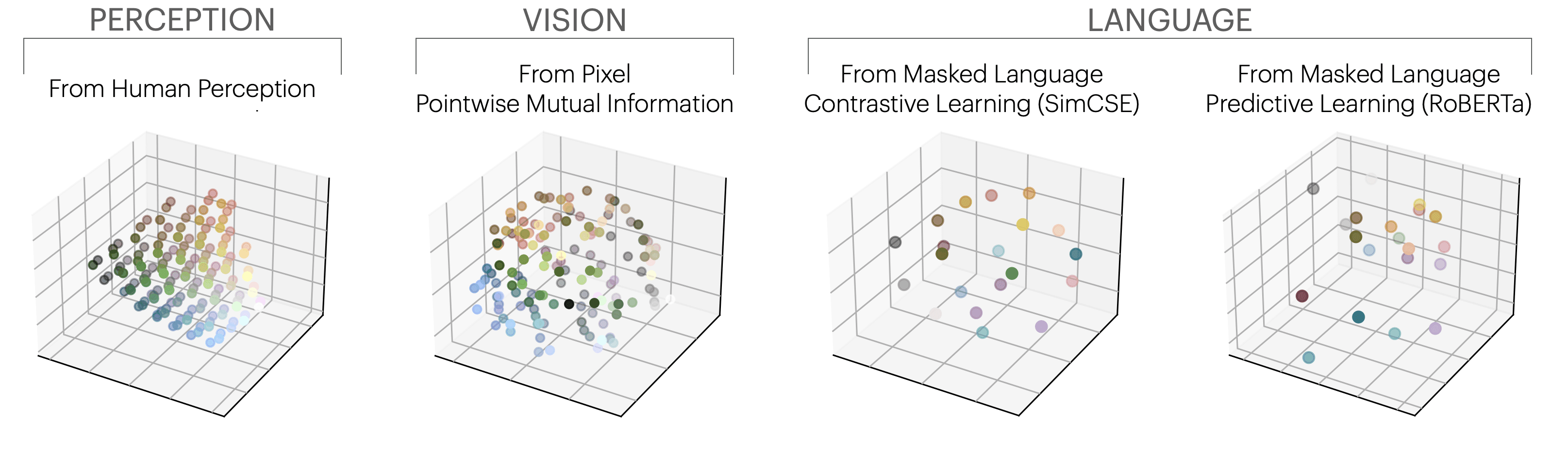
The standard "how LLMs work" story is now universally familiar: tokenization, transformer blocks, and next-token prediction. From that framing, it is remarkably easy to land on the "stochastic parrots" critique: if the objective is just statistical prediction, surely the system is only remixing surface patterns rather than learning anything that truly transfers.
But there is a much more fascinating technical question hiding underneath, one that goes straight to the heart of learning theory: What internal representations are forced to exist if a model is to predict well across an enormous range of contexts?
A popular intuition, often echoed by researchers like Ilya Sutskever, is that sufficiently good prediction inevitably pressures a model to build compressed abstractions that behave like a partial "world model." Recently, we have moved from intuition to empirical observation: we can now measure these representations across models, modalities, and scientific domains. And the results are surprisingly structured.
1. The Platonic Representation Hypothesis and Learning Theory
In 2024, Huh et al. formalized a growing suspicion into the Platonic Representation Hypothesis. The core argument is that as deep models scale, their learned representations become increasingly aligned. Different models, even across modalities like language and vision, start to agree on what is "similar" or "different" in their high-dimensional embedding geometries.
From a learning research perspective, this is not mystical; it is statistical. The manifold hypothesis suggests that real-world high-dimensional data actually lies on low-dimensional manifolds.
- Stable Regularities: As models scale, self-supervised learning (SSL) objectives force them to discard noise and discover these underlying manifolds.
- Metric Convergence: Radically different training setups, whether masked autoencoding or next-token prediction, still converge toward similar "distance metrics" over data points because they are modeling the same underlying reality.
If this convergence is real, the pressure to predict is actually forcing the model to learn abstractions that generalize, finding the actual "joints" of the world.
2. The Ultimate Testbed: Scientific Foundation Models
The most compelling proof that representation is doing something real lies in the hard sciences, where the objective has a tight, uncompromising connection to physical structure.
Consider models like AlphaFold (protein structures) or MACE (quantum physics/DFT calculations for atomic energies). A 2025 paper, Universally Converging Representations of Matter Across Scientific Foundation Models, studied nearly sixty scientific models across strings, graphs, and 3D atomistic inputs.
Two critical findings emerged that keep us intellectually honest:
- High-performing models align; weak models diverge. As models improve, their representations become more similar. Convergence is not just everything collapsing to statistical noise; it is a convergence on physical truth.
- Out-of-distribution (OOD) is still a wall. When faced with structures far from their training data, many of these models collapse to low-information representations.
This bounded universality proves that while models are finding underlying mathematical strands, their "understanding" is still bounded by data coverage and inductive biases.
3. Why This Matters for Businesses and Builders
If you are working on an AI startup, enterprise software, or agentic applications, representation convergence might sound overly academic. But this phenomenon maps directly to the parts of your stack that actually move metrics, drive ROI, and lower compute costs.
Here is why this underlying learning research is a massive tailwind for product engineering:
- Transfer Learning Keeps Getting Cheaper: The Platonic Representation framing justifies why small heads on top of frozen models work so well. Because representations are converging on stable, linear regularities, you do not need to fine-tune a massive 70B model from scratch. You can freeze the foundation model and train a tiny, cheap adapter like LoRA for your domain.
- The Backbone of Reliable RAG: Better representations directly yield better embeddings. Even if raw text generation quality plateaus, continuous improvements in representation quality mean stronger semantic search, better clustering, higher-quality reranking, and more stable intent classification.
- Agentic Tool Use: A clean mental model for AI agents is: LLM + Memory + Planning + Tools. The glue that makes tool use reliable is representation quality. To select a Python interpreter over web search or to ground a response in the right database state, the agent must map messy intent to rigid software constraints.
4. Grounding the Hype: Why "AGI Tomorrow" Is Too Strong
Seeing models spontaneously align on quantum mechanics makes it tempting to claim we are on the verge of AGI. However, representational alignment does not imply immediate AGI.
Convergence proves models can reliably extract and reuse abstractions. But robust, general-purpose intelligence requires mechanisms that purely text-trained generative systems currently lack, including:
- Reliable long-horizon planning.
- Grounded causal modeling (acting and predicting consequences, not just observing).
- Memory and state tracking beyond the context window.
This is exactly why researchers like Yann LeCun advocate for objective-driven AI and architectures like JEPA (Joint Embedding Predictive Architecture). The goal is to learn compact latent dynamics that support prediction under intervention, true world models that can reason and plan rather than only pattern-match.
The Bottom Line
We do not need to claim magic to explain why foundation models feel like they are getting closer to generality.
Scaling and self-supervision force models toward reusable, convergent representations. This shared mathematical space is making it cheaper for businesses to build highly capable, specialized tools on top of general models. Yet true universality remains bounded by data and the missing architectural pieces of agency.
That is a strong, defensible thesis, and it leaves plenty of room for the real hard work ahead.
Cite this article
@misc{burton2025uorlagm,
  author = {Burton, Felix},
  title = {Why Foundation Models Keep Rediscovering the Same Ideas (And What It Means for AI Builders)},
  howpublished = {\url{https://felixburton.com/blog/unification-of-representation-learning-and-generative-modelling}},
  year = {2025},
  note = {Accessed: 2026-04-04}
}